Crucial Conversations (Book Review)

I recently finished “Crucial Conversations. Tools for Talking When Stakes Are High” (Amazon) from Patterson et al, which describes how to productively hold emotionally challenging conversations. The book had been recommended to me by several colleagues.

What is the book about?

crucialconversations200

According to the book, crucial conversations are define as those conversations were:

  • there are high stakes
  • there are opposing opinions
  • there are strong emotions

The aim is, to hold these crucial conversations as a dialog.  A dialog is a conversation where everyone can freely contribute to a growing pool of opinion. In non-dialog conversations people tend to make accusations or don’t contribute their views. In other words: they get violent or silent. Continue reading

flattr this!

Posted in Book Review | Tagged , , , | Leave a comment

ACE! Conference 2013 – My Impressions

I had the opportunity to spend the last two days at the ACE! Conference in Krakow, Poland. ACE! is a nice conference about Agile and Lean practices – this year the guiding theme was Kanban.

aceconference_2013_articleFormat

The conference is one track and every speaker has 30 minutes or an hour to present his topic. At the end, there is no opportunity for questions – that is were the open spaces are for.

There are open spaces for two hours on both days. You can and should use this time to talk directly with the speaker about their ideas or your questions and suggestions. This allows you to really dive into the topics – rather than only getting the answer to one question. And of course, you can discuss any other topic you like.

Content

I’m not going to cover all topics – you can find them here. And there should be videos out soon. But I will summarise a bit.

Continue reading

flattr this!

Posted in Conferences | Tagged , , , , , , | Leave a comment

My Personal Retrospective Plan for 2012

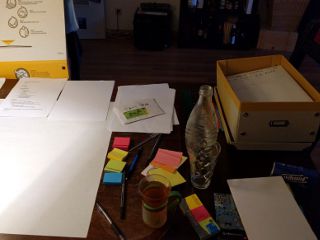
It is time for a personal retrospective, as the year 2012 comes to an end. I took some time on the train to plan my retrospective. plan_pr_articleSo I’m sharing what I plan to do at the 2nd or 10th of January:

  • Intro Music: Listen to my retrospective song, to start the retrospective ritual.
  • Read Retrospective Letter: I write a letter to myself at the end of every longer retrospective. This time I’ll read the letters from 2011, Q1 2012 and the letter from the TWU retrospective.
  • Social Interaction Analysis
    • Queries: I’ll search in Facebook, Xing, LinkedIn, Twitter, E-Mail, Call-Log for some interesting patterns. I will prepare some statistics before the retrospective. In this step I’ll analyse those data.
    • Social MindMap: Integrate the insights gained from the queries into the a MindMap which should includes also the feedback I received directly from my peers. Continue reading

flattr this!

Posted in Personal Retrospectives Series | Tagged , , , | Leave a comment

When to do a Personal Retrospective?

What is the right time to do a personal retrospective? As always, the answer is: “it depends”.

I have done personal retrospectives at different times, using different schemes.

There are two basic schemes I separate the timing of a personal retrospective into:

  • regular retrospectives
  • event triggered and topic oriented retrospectives

Continue reading

flattr this!

Posted in Personal Retrospectives Series | Tagged , , , | 1 Comment

Hunting a Random Bug – A True Story

A few weeks ago, I finished a bug hunt for the RapidFTR open source project, which took me three evenings. I thought it might be worth sharing the story of the hunt.

This article will describe what I did. I will give an overview of my journey to actually find the root cause of what was going on. My goal with this article is to highlight examples of techniques you can use, to actually track down strange and random bug.

In the end, I found a pretty clear explanation what and why the problem happened.  And it is not a coincidence, that there is a ‘random’ in the title of this article. Continue reading

flattr this!

Posted in Programming | Tagged , , , , , , , , , | 3 Comments